Heads Up: “Figure Drawing” by Andrew Loomis

I don’t know whether to believe this or not — other Loomis reprints have been announced before and come to nothing — but an Amazon.ca search of drawing books to be published in 2011 brings up the following:
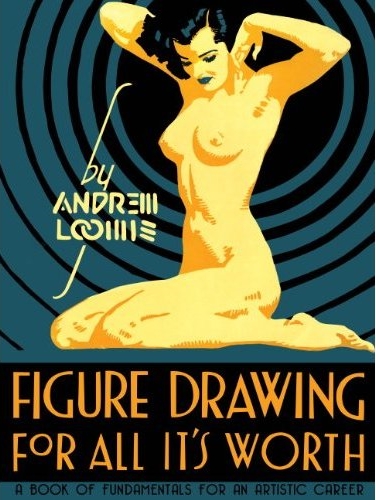
Figure Drawing [Hardcover]

Andrew Loomis (Author)

List Price: CDN$ 46.00
Price: CDN$ 28.84 & this item ships for FREE with Super Saver Shipping. Details
You Save: CDN$ 17.16 (37%)

This title will be released on May 31, 2011.

# Hardcover: 208 pages
# Publisher: Titan Books (May 31 2011)
# Language: English
# ISBN-10: 0857680986
# ISBN-13: 978-0857680983

It’s strange to think that Loomis’s legendary art instruction books are all out of print in English. I read once that the lack of reprint editions had something to do with a certain lack of interest on the part of the copyright holders; however, if the copyright holders have had a change of heart, all I can say is, HALLELUJAH!

Of course, Loomis’s books are all available for download from various sites, but I say that a book in the hand is worth a dozen on the hard drive.

UPDATE:

Heads Up Follow-up: FIGURE DRAWING FOR ALL IT’S WORTH! — in which I confirm that the Titan Books reprint is really real.

6 thoughts on “Heads Up: “Figure Drawing” by Andrew Loomis

  1. Very cool. I’ve seen the other digital copies and I’m thrilled that there could be a copy of these amazing books to hold in my hands/open on my studio desk to learn from for years to come.

  2. So glad someone else made a link to those Loomis books online! They used to be viewable (and downloadable) at http://www.saveloomis.org but Walter Foster (the company) owns the rights to them, and forced that site to shut down. Foster has published the books in fragmented pieces which is not at all the same (or acceptable).

    One caveat I’ll warn the serious art student, however: Loomis was a great illustrator, but for some reason he completely muffed the anatomy from the middle of the shins down (pages 60, 64, and 65 in FIGURE DRAWING FOR ALL ITS WORTH). He wrongly draws the tibialis anterior (or anticus) as going straight down the shin (when it begins at the bottom of the ilio-tibial band, then runs diagonally across the shinbone until it ceases at the side of the foot near the big toe), and omits the deep tendon of the extensor hallucis longus (which emerges into view about midway of the tibia, moving due south to the top of the big toe), and Loomis also ignores the peroneus brevis as being separate from the peroneus longus. Furthermore, he omits the flexor digitorum longus which surrounds the inner ankle (just below the soleus). Oddly, he only shows diagrams of the front, outside, and back view of the leg, but not the inside view.

    I know this sounds a bit like medical school here, but beginning artists need to nail down these anatomical basics. Also, there’s no ethnic diversity in these (all Caucasian males and females). I’ve compared these Loomis drawings with those of many others (Richer, Bridgman, Hogarth, etc.).

    On a lighter note, there are drawings he did in FIGURE DRAWING FOR ALL ITS WORTH (pages 76 and 77) in which he shows the simplified planes of the human body, and one can see where the second version of Ice Man (of the silver age X-Men) came from.

  3. My understanding is that the Loomis family currently holds the copyright to Andrew’s books, not Walter Foster Publishing. The books were originally published by The Viking Press, not by Walter Foster, which has only ever published a small amount of instruction by Loomis, presumably via a separate deal, seeing as The Viking Press and Walter Foster were separate companies; however, even when the books were in print with Viking, Andrew Loomis himself retained the copyright. It wasn’t work for hire. So when Loomis died, the copyright passed to his heirs — first his wife, and when she died, their kids.

    If Walter Foster Publishing at some point purchased the publication rights to all of Loomis’s books, why would the company not reprint them? Nothing Walter Foster currently publishes would sell as well as new editions of Creative Illustration, The Eye of the Painter, Figure Drawing for All It’s Worth, etc. And if the folks at Walter Foster don’t know that, they’re incompetent.

    Walter Foster, btw, has two books scheduled for publication in 2011 that might be worth a look:

    How to Draw Classic Heads & Faces: Step-by-step art instruction from the vintage Walter Foster archives (128 pages) — “In How to Draw Classic Heads & Faces, the first book in the new Walter Foster Collectibles series, artists can step back to a simpler time and become acquainted–or reacquainted–with the roots of Walter Foster’s art. Gracing each beautifully designed page of this must-have collector’s title are original step-by-step instructional drawings and art tips from four books that helped artist Walter Foster grow into the legend he is today: How to Draw the Head, Heads from Life (18), Heads from Life (18A), and 101 Heads. Practical advice and easy-to-follow instructions make this inclusive drawing book as relevant today as when the original titles were first published.”

    How to Draw & Paint Pin-ups & Glamour Girls: Step-by-step art instruction from the vintage Walter Foster archives (128 pages) — “The second book in the Walter Foster Collectibles series, How to Draw & Paint Pin-ups & Glamour Girls, hails back to an era when Betty Grable set the standard for female beauty and Bettie Page set the standard for female allure. This extraordinary collection includes original art from several previously published vintage Walter Foster titles, including How to Draw the Figure, Pin-Up Art, the Nude, Oil: Faces & Features, and Dancers in Action. From the quintessential 1920s flapper girl to a pin-up bikini model, artists will learn to draw and paint a range of female subjects and portraits in a variety of media, including pencil, oil, and pastel. With easy-to-follow step-by-step instructions and professional tips, this collectible book is a must-have for artists of all levels, particularly those fond of days gone by.”

  4. BTW, Chris, while I understand your reservations about Loomis’s anatomical charts, I don’t see that Loomis’s slight anatomical misunderstandings actually prevented him from drawing convincing figures from head to toe. What’s more, I find it hard to believe that any serious student of figurative art would rely solely on the rudimentary anatomical charts in Loomis’s book for their education in anatomy. Because I think it’s plain to see that Figure Drawing for All It’s Worth isn’t a book about anatomy. It’s a book about expressive figure drawing from imagination and from life that includes a short introduction to anatomy. First-rate books for figurative artists who seek deeper knowledge of anatomy include Classic Human Anatomy: The Artist’s Guide to Form, Function, and Movement by Valerie L. Winslow and Atlas of Human Anatomy for the Artist by Stephen Rogers Peck, and the subject matter they cover is, for the most part, significantly different from the subject matter covered in Loomis’s book. (Actually, if you think of Winslow’s and Loomis’s books as defining two points, widely separated, on a continuum, Peck’s book lies somewhere in the middle.) But then again, the serious art student will not be satisfied with only two books on anatomy; he or she will always be on the lookout for something better.

  5. I studied Peck’s book in my student days. Also had Grey’s anatomy (which really seems more fitted for doctors than artists) and one with reproductions of drawings by Vesalius. Very glad Loomis is coming back in print, though!

  6. You must have done something right, Chris. Your explanation of the errors in Loomis’s drawings of the musculature of the lower leg was clear, precise, and correct.

    Also, I did laugh when I read your Ice Man comment. You might be right! :)

Leave a Reply

Your email address will not be published. Required fields are marked *

*

You may use these HTML tags and attributes: <a href="" title=""> <abbr title=""> <acronym title=""> <b> <blockquote cite=""> <cite> <code> <del datetime=""> <em> <i> <q cite=""> <strike> <strong>