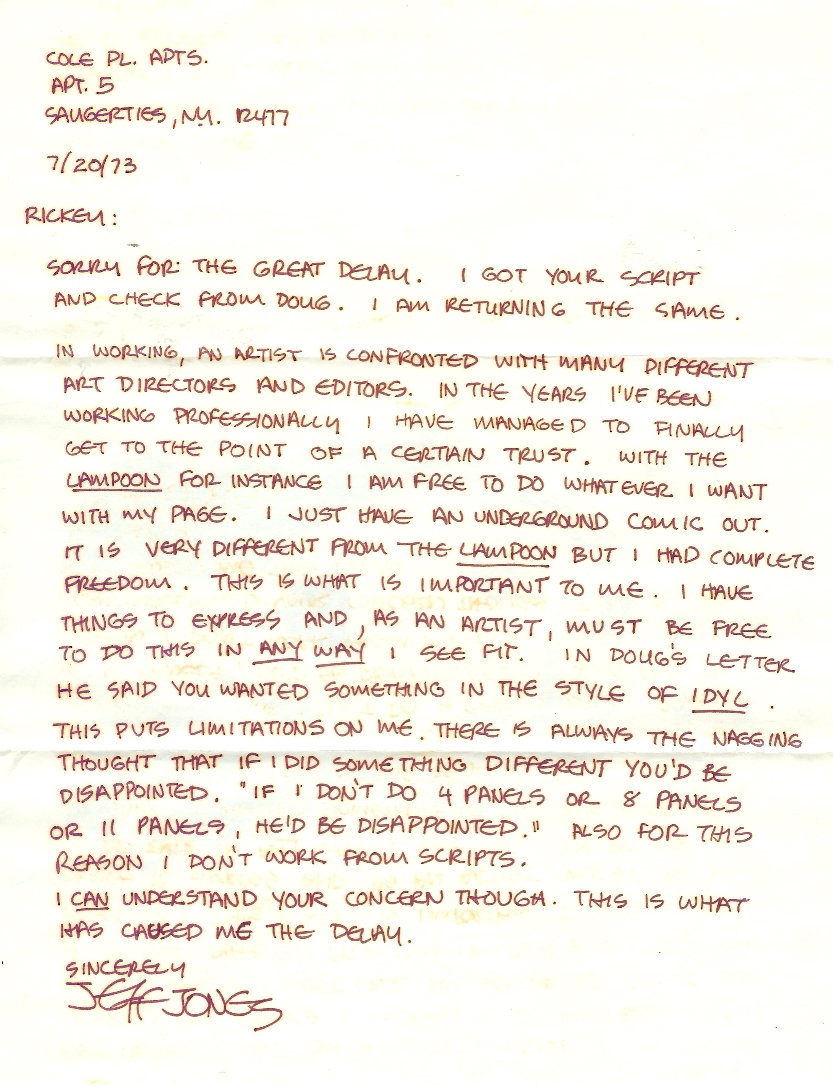
Back in 2009, art collector and big-time Jeffrey Jones fan, Rob Pistella, generously invited me to use scans from his Comic Art Fans gallery on RCN. The first item I highlighted was a letter by Jeffrey Jones dated 7-20-73. The second is right here:

Facebook Tumblr Twitter Email
 

From Marvel Fanfare #8 (May 1983), “The Bill Sienkiewicz Portfolio,” coloured by Christie Scheele:

Notice Sienkiewicz’s Jeffrey Jones-inspired signature. Not really any evidence of Jones’s influence in the drawing, however. Ralph Steadman, maybe. Bob Peak, definitely — especially in the Thor image, but in some of the others as well. Neal Adams, definitely — all over the place. Jones, not so much.

To my eye, at least.

For one thing, Sienkiewicz’s figures are just not specific enough. They’re not carefully observed. There are no details that make you think, yes, that’s how a body really looks, and yes, that’s how it moves! Jones’s best drawings are filled with such details.

Seven years later, Sienkiewicz was hard at work on the artwork for Big Numbers, where he combined a loose mixed-media illustrative technique with extensive photo reference. Here’s a random sample from issue #1, as featured on Bill Sienkiewicz’s official Web site (where the style is explicitly identified as “photo-realistic”):

And here’s another:

It was a relatively original synthesis of the influences that Sienkiewicz had formerly worn on his sleeve, but still — to my eye — Sienkiewicz’s Big Numbers style owed more to work such as Richard Diebenkorn’s mixed-media figure drawings (see, for instance, Diebenkorn’s Seated Woman No. 44 [1966] posted below) — along with a certain highly influential school of heavily photo-referenced but painterly illustration art that emerged in the 1960s and steamrolled into the 1970s and beyond (Bernie Fuchs comes to mind here; and Robert Heindel) — than it ever did to Jones’s Idyl or I’m Age strips.

Nor did Sienkiewicz’s work have to resemble Jones’s, for Sienkiewicz to claim Jones as an influence.

Because the simple fact is, one can be influenced by a fellow artist’s example of artistic independence, integrity, and experimentation without latching on to specific aspects of his or her style…

BONUS IMAGE:

From 1988, a page from Stray Toasters, to compare with the illustration by Robert Heindel that I linked to earlier:

Facebook Tumblr Twitter Email
 

Here’s another justly forgotten Lin Carter novel, half of an “Ace Double,” with cover art mistakenly credited on the verso of the title page to Kelly Freas even though the art is clearly signed “Jones”:

jeffrey-jones_tower-of-the-medusa_ny-ace-1969

ABOVE: Lin Carter, Tower of the Medusa (New York: Ace, 1969), with cover art by Jeffrey Jones.

Facebook Tumblr Twitter Email
 

New from Todd Adams and Glimmer Graphics: a beautiful signed-and-numbered Giclée print of a shimmering seascape by Jeffrey Jones entitled The Great Cloud. The print is strictly limited to 75 copies and is available now!

Facebook Tumblr Twitter Email
 

JEFFREY JONES
71 WITTENBERG RD.
BEARSVILLE, NY 12409

Dear Mr. Weaver,

I’m sorry this took so long.

You asked about the proudest moments of my career. I don’t think I sit around and think about the past. There are artists who like to paint and those who like to have painted. I like to paint. I love to paint. The drawing, the way colors leap to life next to each other. I had a teacher once who said “There’s no such thing as an ugly color, it depends on what it’s next to.”

Good luck.

Sincerely,
Jeff Jones

Facebook Tumblr Twitter Email
 

Here’s some more early work by Jeffrey Jones, scanned from the RC library, and I have a strong suspicion, dear reader, that at least one of these covers will be new to you:

Frankly, I don’t trust the publication date in The Unending Night… but until I learn different, I’m going to leave it as is…

Facebook Tumblr Twitter Email
 

This past weekend, I finally located (and purchased) a copy of Gordon R. Dickson’s Wolfling, with cover by Jeffrey Jones, so now, at last, I can post this comparison of two very similar images by Jones executed in two different mediums, oil vs. ink:

The “Conan” frontispiece was published in Savage Sword of Conan in 1975, but the style and the signature suggest to me that it was created around the time of the 1969 Wolfling cover. Anyone know if the “Conan” frontispiece was published anywhere else prior to its appearance in Savage Sword?

Facebook Tumblr Twitter Email
 

The W. C. Fields Book (Brooklyn: Wonderful Publishing Company, 1973) is identified in the indicia as a “special issue of Witzend (No. 9).” Witzend was an underground comics magazine launched in 1966 by E.C. legend Wallace Wood and published and edited by him until 1968, when he sold the magazine, for a buck, to Bill Pearson/Wonderful Publishing Company. Here’s the cover with Jones’s painting of W. C. Fields, which, by the way, is reprinted at a small size but sans text and in full colour on page 64 of Jones’s first solo art book, Yesterday’s Lily (Dragon’s Dream, 1980):

jeffrey-jones_cover_witzend-09

And here — SURPRISE! — is an extremely obscure illustration by Jeffrey Jones, published in black-and-white in National Lampoon, vol. 1, no. 23 (February 1972), along with an article entitled “The Thoughts of Chairman Fu-Manchu”; the painting has never, to my knowledge, been reprinted:

jeffrey-jones_the-thoughts-of-chairman-fu-manchu_national-lampoon-v1n23-feb1972_p66

The washy, rub-out style of the “Fu-Manchu” painting, which can be accomplished most easily with oil paints but is also possible in watercolour/gouache, was state-of-the-art in the late 1960s and early 1970s. Three of the best known practitioners were Society of Illustrators Hall of Fame inductees Bernie Fuchs, Burton Silverman, and David Levine, but many others tried their hands at it, too — including Jones, apparently. To learn how to do it in watercolour, all you need is a copy of Silverman’s Breaking the Rules of Watercolor, a selection of watercolour paints and brushes, a few rolls of good-quality paper towels, a large tube of white gouache, a stack of the heaviest weight Strathmore plate bristol you can find, AND THE PATIENCE OF JOB!

BONUS CONTENT:

Here’s an album cover, not by Jeffrey Jones, with a portrait of W. C. Fields that appears likely to have been based on the same photo reference of Fields as Jones used for his painting; the accoutrements are slightly different in the two portraits, but the face, I think, is a dead giveaway:

I suppose it’s also possible that one portrait was based on the other (though it seems to me unlikely). Either way, however, Jones’s W. C. Fields genuinely looks like the kind of man who keeps a supply of stimulant handy in case he sees a snake, which he also keeps handy, while the other Fields looks like he has been living for days on nothing but food and water. Can you guess which one I like best? Wrong again. I prefer Jones’s version.

Facebook Tumblr Twitter Email
© 2012 Ragged Claws Network Suffusion theme by Sayontan Sinha