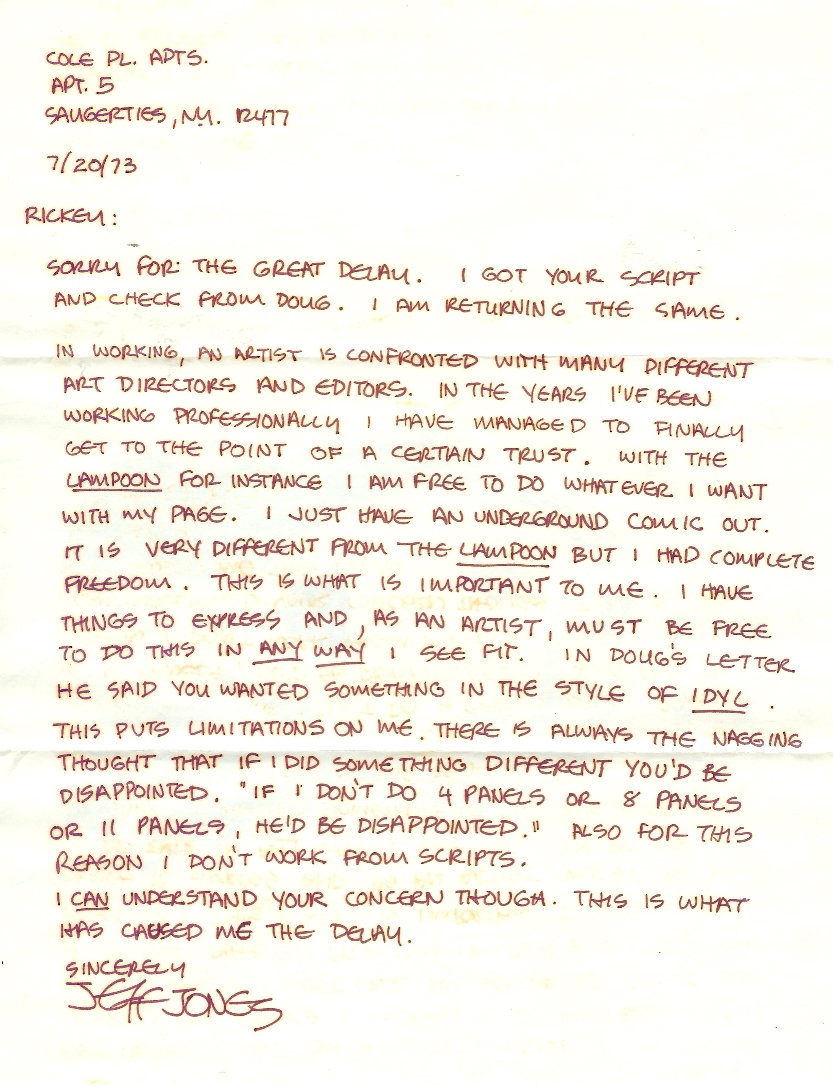
Here’s Jeffrey Jones on Michael Wm. Kaluta, from Comic Book Profiles #7: Michael William Kaluta (Summer 1999), pages 28 – 29:

How did you first meet Michael?

If memory serves, I met Michael and Bernie Wrightson at a New York City convention in the fall of 1968. Michael may dispute this because he is the “memory giant.” But I remember this as being so. We were there to show our fledgling work. I had arrived in New York about a year earlier and had a couple of jobs done. My memory is sketchy as to details but Bernie had a bunch of $5 and $10 ballpoint pen drawings piled on a table in the art show for sale. Michael was more of the portfolio type. I mention Bernie in the Michael question because he was the one who introduced us.

What do you feel is his strength as an artist?

Michael’s greatest strength as an artist has always been his ability to remind us to stay alive. His art is moral in the sense that it, as the best art, has absolutely no function except to exist. It has the promise of function and will remain where that beauty lives. I speak of the human spirit and its passion to rise above everything, except that which we all already know. Michael reminds us of that connection between all lives and all that makes us human. This takes a true artist.

You and Michael worked on projects together, both formally and informally. Does any one project stand out as particularly memorable?

The thing that jumps to mind is a period of time during The Studio days, if you will, when we were trying to decide what to call our upcoming book (The Studio). Michael taped long rolls of brown kraft paper to one wall where each of us, usually clandestinely, would write our suggestions. Well, this certainly started out seriously but quickly degenerated into a list of some of the most preposterous titles imagined by the minds of the deranged. I believe that even though most of these would appear in the dark of night, it was pretty easy to tell who wrote what. We laughed for what seemed months. Definitely a great achievement in the art of cooperation.

Now, it seems to me that what Jones viewed as the “greatest strength” in Kaluta’s work back in 1999 is precisely what Jones has always pursued in her own work.

And I have little doubt that Kaluta was, at the time, flattered by Jones’s praise; I mean, who wouldn’t be?

And yet, based on the very plain-spoken, practical analysis that Kaluta offers up in an early promotional trailer for Better Things: Life + Choices of Jeffrey Jones of the difference between his own unabashedly functional, commercial body of work, and the sometimes obliquely functional but always deeply felt and humanely expressive work of Jones, I’m not entirely sure that Kaluta actually would have agreed with Jones’s contention that his (Kaluta’s) artwork “has absolutely no function except to exist.”

Here is a partial, lightly edited transcript of the trailer, which features a rough-cut interview with Kaluta:

Artistically, [says Kaluta] one works for oneself. You have to. To get anything good, you kind of have to work for the person that’s inside of you; however, to be able to live, you have to work for companies. I had to work for companies; other artists, perhaps, can work for galleries, or posterity. An illustrator is someone who draws for money. I don’t do what some of my friends are able to do, which is paint their souls, their dreams, their nightmares for themselves, and that’s art — and it is. I am happiest when I am reading someone else’s material and crafting it into a picture that will reflect to my best efforts what I think the writer was trying to say, trying to visualize. I would say that Jeffrey Jones is both an illustrator and an artist, using the descriptions we have just talked about. He covers a wide range of self-motivating imagery. It comes through him, and every once in a while he’ll apply that specific power that comes through him to an illustration job, or he’ll use the characters that have been written by other people as a vehicle for his own talents. I wouldn’t say he’s as much of an illustrator as I am. I think that he’s more of a personal storyteller who now and then might come close to illustrating something [laughs], on purpose.

In the portion of the trailer I haven’t transcribed, Kaluta goes on to describe his first meeting with Jones, which Kaluta says occurred at “a World Science Fiction Convention here in New York City in 1967.” LOL!

Facebook Tumblr Twitter Email
 

Coming this October from IDW, in both a regular hardcover and a signed and numbered limited edition:

Jeffrey Jones: A Life in Art

PRODUCT DETAILS:

* Hardcover: 256 pages
* Publisher: IDW Publishing (Oct 5 2010)
* Language: English
* ISBN-10: 1600107370
* ISBN-13: 978-1600107375

PRODUCT DESCRIPTION:

Over the past 40 years, there have been few artists who have received as much acclaim and garnered as much attention as Jeffrey Jones. From his early comic book work for Heavy Metal and National Lampoon to his popular book covers for such authors as Dean Koontz and Andre Norton to his move into fine art, Jones has inspired generations of painters and artists. This beautiful volume of his personal favorites will only enhance his reputation and cement his standing as one of America’s greatest living artists.

The cover design of the new volume is very similar to the design of the Jeffrey Jones Sketchbook, which was published by Vanguard and has now gone out-of-print:

Need I add that the new collection is very exciting news!? In fact, I’ve already placed my order for the limited signed and numbered edition. Hope I get one.

BONUS “HEADS UP”:

The hardcover edition of The Art of Jeffrey Jones (Underwood, 2002) is currently on sale at Budsartbooks.com for US$14.95, while supplies last. The deluxe, slipcased edition was also on sale a short time ago — I know because I bought one, even though I already had the regular hardcover, which I purchased at full cover price — but it’s now sold out. Sorry I forgot to mention…

Facebook Tumblr Twitter Email
 

I purchased the following Andre Norton paperbacks with covers by Jeffrey Jones on Monday from a small shop in Yorkton, Saskatchewan. I found the shop totally by accident. My wife, our son, and I were en route to Dauphin, Manitoba, but since we were ahead of schedule and had some time to kill before lunch in Yorkton, we decided to drive around a bit and see what stores were open in the downtown area. We went up and down a couple of streets, and then we noticed a shop called “Thrifty Mama’s” that had a display of books in the window. Being a trio of bibliophiles, we couldn’t resist checking it out — and discovered that at least half of the floorspace in “Thrifty Mama’s” is dedicated to used books, mostly paperbacks. Score!

Now, I know I’ve posted the cover of Uncharted Stars before, but the book this time around is in much better condition. In fact, all four are really glossy and tight. And they all sport excellent Jones covers. Enjoy!

Facebook Tumblr Twitter Email
 

The cover of The Three Faces of Time, which I bought yesterday at a used book store in Moose Jaw, Saskatchewan, is uncredited, and no signature is visible, but it sure looks like the work of Jeffrey Jones, circa 1968-69, to me.

ABOVE: Jack Williamson, Seetee Shock (New York: Lancer, 1968), with cover by Jeffrey Jones.

jeffrey-jones_the-three-faces-of-time_ny-tower-1969

ABOVE: Frank Belknap Long, The Three Faces of Time (New York: Tower, 1969), with cover by Jeffrey Jones.


UPDATE (24 July 2010):

This just in: reader Patrick Hill points out in the comments section of this post that Jones informed him ten years ago that he (Jones) swiped the pose of the main figure in Seetee Shock and The Three Faces of Time from “H2O World,” with story by Larry Ivie and art by Al Williamson and Roy Krenkel. Here’s the ocular proof:

williamson-krenkel_h20-world_creepy_n1p10_1964

ABOVE: Al Williamson and Roy Krenkel (artists), first page complete, "H2O World," Creepy #1 (1964), page 10.

williamson-krenkel_h20-world_creepy_n1p10_1964_detail

ABOVE: Al Williamson and Roy Krenkel (artists), first page detail, "H2O World," Creepy #1 (1964), page 10.

If nothing else, the above news should make Maroto fans smile.

Facebook Tumblr Twitter Email
 

This story from Epic Illustrated #27 (December 1984) not only is “dedicated to the memory of Roy G. Krenkel” but also includes a lovely tribute to Jeffrey Jones, whose girl sculpture — see also below — according to comic-book creator, film-maker, and friend of Al Williams, Kevin VanHook, typically sat behind Williams at his drawing board around the time the story was created. Also, in the comments section of this post, regular participant on this site, Chris A, astutely points out that Williamson based the character of Kirth on Stewart Granger (1913 – 1993), a British actor with whose work I myself am almost entirely unfamiliar. Williamson has made Kirth’s nose somwhat shorter and more rounded than Granger’s, but Granger is definitely Williamson’s model here. Enjoy!

Facebook Tumblr Twitter Email
 

The first page here is by Esteban Maroto. It is from a story called “Idi and Me,” written by Bill DuBay, that first appeared in issue #4 of the Warren magazine, 1984, way back in 1978. And though the script is junk, it’s an attractive page. Only problem is, all of the female figures are very clearly swiped from Jeffrey Jones’s celebrated comic strip, Idyl, which ran in National Lampoon from 1972 to 1975. See below for the ocular proof:

For those who haven’t read 1984 #4, which would be almost everyone, the woman in the DuBay-penned “Idi and Me” is the brutal dictator, Idi Amin, whose chromosomes have been jumbled, just for laughs, by the American “Department of Dirty Tricks” (DDT), thereby turning “the former gorilla-faced leader of Uganda into this heavenly image of white Anglo-Saxon femininity,” Idi, who nonetheless retains a male psychology and sex drive and is thus seeking an operation to change back into a man. (And the final line/moral of the story? “I guess no matter what form you’re in… the world just isn’t ready for Idi Amin!”) All of which seems very odd, given Jeffrey Catherine Jones’s own difficult journey; however, the story did appear way back in 1978, as I noted above, which is about 20 years, more or less, before Jones decided to take definite steps become a woman. So what’s going on here? Seems most likely to me that it’s just a coincidence — though if it isn’t, if DuBay is taking a shot at Jones’s sexuality based on industry rumours, private confidences, or whatever, it’s an incredibly crude commentary! I mean, why would DuBay have done it, and why on earth would Maroto have participated? It doesn’t make sense to me, though, of course, even if the sex-change theme is a coincidence, it doesn’t mean that the story of Idi wasn’t intended, in part, as a parody of Jones’s Idyl. That would certainly explain the blatant swipes, except that Maroto has swiped from Jones (and others) before. So maybe the simple answer is that Jones’s work on Idyl was so skillful, so sensitive, so gorgeous, and — perhaps it seemed to Maroto — so obscure, that it was ripe for the swiping… or not… because the fact is, I’m not sure what to think…

Anyone have any ideas?

Facebook Tumblr Twitter Email
 

The numbers and dates of these covers by Jeffrey Jones are included in the file names. They’re displayed here in order of publication, earliest first, latest last, 1969 to 1980.

Facebook Tumblr Twitter Email
 

These figure studies by Jeffrey Jones are undated, but my guess is that they’re from some time in the 1970s:

BONUS LINK:

Corben Studios: Figure Gallery

Facebook Tumblr Twitter Email
© 2012 Ragged Claws Network Suffusion theme by Sayontan Sinha